Monday, May 24, 2010


Sunday, May 23, 2010
Amonsito workers face security crackdown

After being kicked out of a parliament session in the early afternoon of March 23, Amonsito workers faced police brutality. Security forces kidnapped 6 workers and are now holding them at police stations. Security deny their presence at qasr alnil and sayeda Zeinab police stations despite witness accounts of their presence there
see witness accounts here
Wednesday, May 19, 2010
Visiting An Egyptian Worker Intifada

On May 18 the sidewalks of the Egyptian Parliament is packed with workers.
Leading the crowd is the 14-year-old daughter of the union leader.

In the heat of the day, about 30 workers from the Amonsito textile factory huddled under the shade of a tree.
“We are not workers, we are rejects,” the factory union leader Khaled el-Shishawy, who is known simply as sheikh Khaled said.
The workers returned after government officials and the crediting bank shirked responsibility on an agreement signed 55 days earlier.
Before returning 12 days ago, sheikh Khaled told me, “If we return to our sit-in, it won’t be the same as last time. Things will be different.”
More pictures of the workers' sit-in here.
The Shattering of the Egyptian State- Labor Uprising in Review
Kareem el-Beheiry was 20 years old when he first took part in a labor strike in December 2006.
"I didn't know what a strike was," said el-Beheiry, the Mahalla Textile Factory's first blogger.
The next day he saw a scene that changed his life. "I saw a woman crying in front of a TV camera, saying she could not feed her kids."
The blogger, shocked by the scene, thought to himself, "Does this really exist in Egypt?"
It does, according to Esam Shaban, a researcher at the Afaq Ishtiraqeyya Center. Over 80 percent of Egyptians are poor, Shaban says, and conditions have worsened over the past five years.
While the Egyptian government often claims that increasing poverty is a result of global market fluctuations, others suggest that Egypt's problems are the direct result of growing gentrification and the government's economic policies.
In the late 1990s the government began privatizing industry, which had been under state control since the 1950s. The education and health sectors were then privatized in the early 2000s. Many factories that had previously been nationalized were bought by foreign investors seeking quick profits. They were attracted by Egypt's lax labor laws, accentuated by a new law in 2003.
In the mid-1990s, farmers were stripped of the protective laws as the government stepped in to protect large landowners and cut subsidies to small farmers.
"Today even working two jobs is not sufficient to provide for a family," Shaban says. "It has caused an economic crisis and people can't remain quiet about this." Many Egyptians have taken to the streets to protest their economic plight.
"On the Egyptian street," says Shaban, "the individual act of discontent became a collective act of protest."
A turning point came in December 2006 when over 24,000 workers at a state-owned textile factory in the Nile Delta city of Mahalla launched a massive strike. On the third day of the strike, labor leader Jihad Taman noticed el-Beheiry filming and thought he was a security agent. When el-Beheiry showed him his factory ID card, Tamam took el-Beheiry under his wing.
The December 2006 strike broke down a barrier of fear among Egyptian labor activists. By the time of the next strike, in September of 2007, the blogger and his fellow strikers were chanting against the World Bank's role in the "colonization" of Egypt and calling for the downfall of President Hosni Mubarak.
News and images of the 2006 and 2007 uprisings spread across Egypt like a virus. Soon, strikes, sit-ins and protests were springing up all around the country.
On 6 April, 2008 food prices hit a new high, and once again Mahalla was the site of dissent.
With the aim of preventing another major strike, security forces closed the textile factory compound. State security trucks from around Egypt surrounded the Delta city. Workers subsequently called off the strike as security made it impossible for them to congregate.
Mahalla, however, was not easily pacified. When security forces beat a woman and her daughter, they ignited the people's anger. For days the clashes continued, with scenes reminiscent of the Palestinian Intifada becoming a reality on Egypt's streets.
Infrastructure, like police cars and train tracks, were set ablaze with the intention of sending a message: Under this regime, life has become unbearable.
In the 6 April uprising, the demands of the workers and the general population overlapped. People called for lower food prices as workers called for a minimum wage.
During the 6 April strike, state security agents arrested and tortured el-Beheiry along with many other labor activists. He was released 73 days later. In 2009, the government transferred el-Beheiry to Cairo and in 2010 he was fired.
In May 2008 a 10,000 person sit-in of real-estate tax collectors caused the government to give in to demands for a 300 percent wage increase. On 21 April 2009, thousands of tax collectors gathered at the Ministry of Manpower and Immigration, forcing Minister Aisha Abdel Hady to recognize their independent union, the first in Egypt since 1957.
At the end of 2009 more and more sit-ins moved to the sidewalks of downtown Cairo. When workers' calls for government interference--particularly in recently privatized factories--went unheeded, they moved to the gates of parliament.
On 8 February workers of the Tanta Flax and Oils Factory started a sit-in on the doorstep of the Council of Ministers in downtown Cairo. In January, the factory's union head, Salah Mosallam, along with nine others were fired in retribution for launching a number of strikes in Tanta. After the Saudi factory owner locked the factory, workers moved their protest to downtown Cairo, calling for their re-instatement or severance payments in accordance with Egyptian law.
"The example of the Tanta Flax Company has proved that the policy of privatization is a failure," said independent MP Gamal Zahran.
After more than two weeks of sitting-in, the roughly 400 protestors rolled up their blankets and went home after the union head came to an verbal agreement with Minister of Manpower and Labor Aisha Abdel Hady and the factory representatives.
But while the Tanta workers may have been temporarily placated, their action brought about a new tactic for Egypt's labor movement. Their 16-day sit-in started a new wave of sit-ins on the sidewalks of the Egyptian parliament.
Workers from the Salemco and Amonsito companies repeated the Tanta Flax scenario almost as if they were following the same script. It seems as though workers have discovered that in order to have their voices heard, they must take their protests to the streets of Cairo.
So far, even this kind of pressure has only brought limited results as factory owners have repeatedly neglected to uphold the promises they make to force the workers off the street. A few weeks after their settlement, the Tanta Flax and Oil Company workers were back on the streets of downtown Cairo.
While the ongoing strikes have empowered Egyptian labor activists, conditions are still not ideal.
"We say the street is ours, but when security forces beat Bahaa Saber in public and then tortured him behind closed doors, this remains only a slogan," says Mahalla blogger el-Beheiry, referring to the 6 April 2010 protest at which an activist was violently beaten in front of masses of onlookers and rolling video cameras.
"Protests don't show the democracy of the government, they prove the failure of the government, they show there is no government," el-Beheiry says.
The Egyptian government's inequitable economic policies are working to shatter the concept of the state as a paternal figure, according to Shaban. "Confidence in the state that controls everything, that turns the water on and off, has been lost."
El-Beheiry thinks that protests need to be combined with direct action. "I like the idea of workers in Argentina. Let us privatize the factories for ourselves. This must be tried in Egypt," he says, referring to events during Argentina's 2001 economic crisis where factory owners fled the country with their savings and workers took over factory administrations and ran the shop floors themselves.
On 19 February MP Nasha't el-Qassass from President Mubarak's National Democratic Party called for protestors to be shot. The parliament responded by recommending to him to the Values Committee.
The following day protesters held placards reading, "Shoot us."
"The media has been central in spreading the news of protests," Shaban says. Today protesters are benefiting from the coverage of local and international media outlets as well as citizen journalism tools, like blogs, twitter, and live video feeds.
Last month, lawyer Khaled Ali from the Egyptian Center for Economic and Social Rights handed in the papers for a case calling on the Egyptian government to set a fair minimum wage. Hundreds gathered at the Minister's Council lead by Independent Tax Collector Union head Kamal Abu Eita chanting, "For those living in castles, a maximum wage, for those living in graves, a minimum living wage."
On 1 May, sugar factories in the Qena Governorate went on strike due to unbearably low wages. At the end of April, 9000 workers at an aluminum factory in Naga Hamadi called for the implementation of a LE1200 a minimum wage.
Meanwhile, the five different groups of protesters on the sidewalk of the parliament buildings united to raise their voice in protest on May Day.
"On Labor Day, workers are supposed to be given benefits, year after year we are being given crises," says el-Beheiry.
Later today, workers and activists from all around the country will protest before the Council of Ministers. They will call for the implementation of a court case that was raised and won by worker Nagy Rashad against the Egyptian government. According to the court ruling, the prime minister is required to introduce a minimum living wage in accordance with market prices by 1 May. The current minimum wage, set in the mid-1980s, is LE35.
Meters from where many of the sit-ins have been taking place, an old mural reads, "Democracy ascertains the rule of the people." But for the people sleeping on the sidewalk, this sounds like a hollow platitude.
Tuesday, May 18, 2010
Workers of Egypt in Solidarity with the People of Greece on the 20 May Strike
From across the Mediterranean we have been witnessing the economic crisis and its effects on the people of Greece. For many in Egypt, Europe seems a far distance away, yet the financial realities of our globalized world mean that what happens to our brothers and sisters in Greece does not leave us unaffected.
The intolerable conditions of people in both Greece and Egypt is a direct consequence of the failures of capitalism and policies of neo-liberalism. Both in Greece and Egypt the governing authorities are reducing public sector funding in various spheres, like education, health and services, with the stated aim of "reform."
For the people of Greece the economic decisions taken by their government representatives has translated into a "financial crisis" that is causing widespread suffering of the population. In response the government is again punishing the people of Greece by imposing large-scale public spending cuts.
For the people of Egypt, though there is no report of a "financial crisis," consistent government spending cuts and privatization has also translated into suffering and thus a crisis in every sense of the word. All across the country workers have been holding sit-ins and strikes to protest miniscule government salaries and the illegal actions of privatized factory owners. In Egypt investment is on the rise, but the profits are not "trickling down" to the working class as promised.
We call for the governments of Greece and Egypt to re-shaped their economic agenda to prioritize the needs of people over the profits of investors.
Today, on the streets of Egypt we stand in solidarity with Greek protestors and affirm your stance against capitalism and the tyranny of governments that impose it.
In solidarity,
The workers of Al-Mahalla
The workers of Tanta Flax and Oil Company
The Real Estate Tax Collectors' Independent Union
The Socialist Studies Center
The Workers Preparatory Committee
The intolerable conditions of people in both Greece and Egypt is a direct consequence of the failures of capitalism and policies of neo-liberalism. Both in Greece and Egypt the governing authorities are reducing public sector funding in various spheres, like education, health and services, with the stated aim of "reform."
For the people of Greece the economic decisions taken by their government representatives has translated into a "financial crisis" that is causing widespread suffering of the population. In response the government is again punishing the people of Greece by imposing large-scale public spending cuts.
For the people of Egypt, though there is no report of a "financial crisis," consistent government spending cuts and privatization has also translated into suffering and thus a crisis in every sense of the word. All across the country workers have been holding sit-ins and strikes to protest miniscule government salaries and the illegal actions of privatized factory owners. In Egypt investment is on the rise, but the profits are not "trickling down" to the working class as promised.
We call for the governments of Greece and Egypt to re-shaped their economic agenda to prioritize the needs of people over the profits of investors.
Today, on the streets of Egypt we stand in solidarity with Greek protestors and affirm your stance against capitalism and the tyranny of governments that impose it.
In solidarity,
The workers of Al-Mahalla
The workers of Tanta Flax and Oil Company
The Real Estate Tax Collectors' Independent Union
The Socialist Studies Center
The Workers Preparatory Committee
تابعنا الازمة الاقتصادية التي وقعت في اليونان و الاثر الذي خلفته على الشعب اليوناني. الكثيرون في مصر يرون مسافة كبيرة بيننا و بين اوروبا، الا ان الحقائق المالية لعصر العولمة الذي نعيشه تفيد بان ما يعانيه اخواننا و اخواتنا في اليونان لا يتركنا دون تاثير.
ان الظروف العسيرة التي يمر بها شعبا اليونان و مصر لهي نتاج فشل سياسات الراسمالية و الليبرالية الجديدة. ففي كلا البلدين تقلص السلطات من التمويلات المخصصة لعدة اقسام من القطاع العام، كالتعليم، و الصحة، و الخدمات. و يجري كل ذلك تحت شعار "الاصلاح
يرى اليونانيون ان الخطوات التي اتخذها نوابهم تسببت في ازمة مالية نتج عنها معاناة للشعب على نطاق واسع. فيما ردت الحكومة باقتطاع جزء ضخم من النفقات العامة و كانها تعاقب شعبها.
اما فيما يخص الشعب المصري، فلا تقارير عن "ازمة مالية"، الا ان الاقتطاعات الدائمة للانفاق، الى جانب سياسة الخصخصة، اسهموا في خلق معاناة و ازمات بكل ما تحمله الكلمة من معنى. لقد نظم العمال في انحاء الجمهورية اعتصامات و اضرابات اعتراضا على تدني الاجور و الممارسات غير القانونية من جانب ملاك الشركات المخصخصة. و برغم ان حركة الاستثمارات في مصر في تصاعد، الا ان الطبقات العاملة لم تلمس فوائدها حسبما وعدت.
اننا نطالب حكومتي كلا من مصر و اليونان ان تعيدا ترتيب اجندتيهما بوضع احتياجات الشعب فوق مصالح المستثمرين.
ونحن اليوم متضامنون في شوارع مصر مع المتظاهرين اليونانيين ضد الراسمالية و الحكومات المستبدة التي تفرضها علينا.
رابتة عمال المحلة
عمال طنطا للكتان والزيوت
النقابة المستقلة للضرائب العقارية
مركز الدراسات الاشتراكية
اللجنة التحضيرية للعمال
Sunday, May 2, 2010
Friday, April 30, 2010
the times have changed/ 2 may protest: cairo streets

I am writing you today because of an emergency.
Like in so many places, the dispersion of a neo-liberal economic agenda is threatening to drown many Egyptians alive.
Since 2004, the Egyptian government has applied economic policies that have translated into reduced support- of any kind- for workers and farmers and increased benefits for agro-business owners and entrepreneurs. Meanwhile, the Egyptian economic agenda has entailed fast-track (if selective) economic liberalization, partly to blame for steady inflation in Egypt. Again, this is good for businesses, not workers.
With an unsatiable desire for high FDI (Foreign Direct Investment) quotas, Egyptian authorities are making it easier for foreign businesses to invest in Egypt, including by means of subsidies on gas and electricity and minimal labor regulations. Essentially, this is enabling a double exploitation of Egyptian resources, natural and human, for the benefit of the local business elite and foreign investors.
I want to visit just one of the very particular effects of these kinds of economic regulations: the effect on a minimum living wage.
In Egypt we have an official minimum wage of 35EGP ($6)/ month that has remained unchanged since 1984. A vast number of Egyptian wage earners are making between $50-$100 a month. With severe inflation over the past four years I have no idea how families survive even when breadwinners are working multiple jobs at such rates.
One month ago, on 1 April, Egyptian workers won a court ruling forcing the Egyptian government to set a living wage for both private and public sector workers.The decision requires the Prime Minister to implement a miniumum living wage in accordance with Egyptian market prices by 1 May 2010 or be sent to prison for failing to conform with the court ruling.
A delegation of workers calls on all working Egyptians to join them in their protest in front of the Cabinet of Ministers in downtown Cairo at 13:00GMT on 2 May 2010 to demand that the government enforce the court ruling.
The 2 May protest does not concern merely a single segment of Egyptian society or a specific government policy. It is an action to obtain a living wage to guarantee dignity for all Egyptians; an action to curb the exploitation and oppression Egyptians experience as working people. Furthermore, I don't think such an event concerns only Egyptians, it concerns people at the bottom the world over, who are being trampled for the excess of comfort and luxury of those at the top.
One month ago, on 1 April, Egyptian workers won a court ruling forcing the Egyptian government to set a living wage for both private and public sector workers.The decision requires the Prime Minister to implement a miniumum living wage in accordance with Egyptian market prices by 1 May 2010 or be sent to prison for failing to conform with the court ruling.
A delegation of workers calls on all working Egyptians to join them in their protest in front of the Cabinet of Ministers in downtown Cairo at 13:00GMT on 2 May 2010 to demand that the government enforce the court ruling.
The 2 May protest does not concern merely a single segment of Egyptian society or a specific government policy. It is an action to obtain a living wage to guarantee dignity for all Egyptians; an action to curb the exploitation and oppression Egyptians experience as working people. Furthermore, I don't think such an event concerns only Egyptians, it concerns people at the bottom the world over, who are being trampled for the excess of comfort and luxury of those at the top.
Watch videos of Egyptian workers, celebrities and politicians calling for wide participation of the protest on 2 May (in Arabic)
Pass on the information for the press to cover.
Get unions and syndicates you are connected with, to send letters or videos (similar to those linked to earlier) of solidarity and support. These can be filmed on a webcam and uploaded to youtube or other video hosting sites and the links forwarded to me.
Help spread the word on this uprising of a multitude.
Monday, April 19, 2010
Jonathan Cook: Israeli Press Censorship
A Palestinian member of the Israeli parliament is demanding that a newspaper be allowed to publish an investigative report that was suppressed days before Israel attacked Gaza in winter 2008.
The investigation by Uri Blau, who has been in hiding since December to avoid arrest, concerned Israeli preparations for the impending assault on Gaza, known as Operation Cast Lead.
In a highly unusual move, according to reports in the Israeli media, the army ordered the Haaretz newspaper to destroy all copies of an edition that included Blau’s investigation after it had already gone to press and been passed by the military censor. The article was never republished.
Thursday, April 15, 2010
Richard Falk: The Palestinian solidarity movement has become the successor to the anti-apartheid movement as the primary legitimacy war of...
April 13, 2010
To the Senate of the Associated Students of the University of
California, Berkeley (ASUC):
I am writing to encourage renewed support for Senate Bill 118A (“A
Bill in Support of ASUC Divestment from War Crimes”), including the
override of ASUC President Will Smelko’s veto on March 24, 2010. The
earlier passage of the bill by a 16-4 vote in the Senate has been
widely hailed as a major step forward in the growing global campaign
of divestment and boycott as a means of holding Israeli accountable
for flagrant and persistent patterns of violating fundamental rules of
international criminal law, as well as those portions of international
humanitarian law applicable to military occupation. We have reached a
stage in world history where citizens of conscience have a crucial
role to play in the implementation of a global rule of law, and this
initiative by Berkeley students, if implemented, will be both a
memorable instance of global citizenship and an inspiration to others
in this country and throughout the world.
I would agree that recourse to divestment and boycott tactics should
be reserved for exceptional and appropriate circumstances. Such
initiatives by their very nature deliberately interfere with the
freedom of the global marketplace and the normally desirable free
interplay of cultures, nations, persons, and ideas. There are several
reasons why the circumstances of prolonged Israeli criminality
resulting in acute suffering for several million Palestinians living
under occupation since 1967 present such a strong case for reliance on
the tactics of divestment and boycott.
First of all, it has become painfully clear that neither the United
Nations, the United States, the actions of other governments, nor
world public opinion are willing or able to persuade or pressure
Israel to terminate policies that are both violations of Geneva
Convention IV, governing occupation, and international criminal law,
relating to both war crimes and crimes against humanity. At the same
time, there is reason to believe that efforts by Palestinians to wage
what might be called the Legitimacy War, are having a strong impact on
Israel and elsewhere. It should be remembered that many of the
conflicts of the last 75 years have been resolved by reliance on soft
power superiority, which has more than compensated for hard power
inferiority. In this respect the anti-apartheid movement, waged on a
symbolic global battlefield, created a political climate that achieved
victory in the legitimacy war that was translated, nonviolently, into
a totally unexpected political outcome—the peaceful transformation of
South Africa into a multi-racial constitutional democracy. The
Palestinian solidarity movement has become the successor to the
anti-apartheid movement as the primary legitimacy war of this
historical moment. Berkeley’s participation by way of this divestment
initiative thus takes account of the failure of governments and the
international community to protect Palestinian victims of ongoing
criminality, but also joins in a movement of solidarity that contains
some hope of an eventual peaceful and just resolution of the
underlying conflict allowing both peoples to resume a secure and
normal life.
Secondly, we in the United States face a special challenge as our tax
dollars, economic and military assistance, and unconditionally
supportive diplomacy have shielded Israel from mechanisms of
accountability for criminal behavior. Most recently, the U.S.
Government repudiated the Goldstone Report, a highly respected
fact-finding mission conducted under UN auspices, that had carried out
a scrupulously fair and comprehensive investigation of allegations of
war crimes attributable to Israel and Hamas during the Israeli
offensive in Gaza that started on December 27, 2008, and lasted for 22
days. The Goldstone Report’s main findings confirmed earlier respected
investigations, concluding that the evidence supported overall
allegations of criminal tactics, including intentional efforts to
target in Gaza civilians and the civilian infrastructure in flagrant
violation of the provisions of the law of war, which should have been
particularly upheld in a situation of such one-sided military
operations conducted against an essentially defenseless Gaza, an
unprecedented situation In which the entire civilian population of 1.5
million were locked into the combat zone, and denied even the option
to become refugees.
It should be also noted that the people of Gaza have been subjected to
an unlawful Israeli blockade that has for more than 32 months limited
the entry of food, medicine, and fuel to subsistence levels, with
widely reported drastic harm to physical and mental health of the
entire population. There are two related points here: the allegations
of criminality are abundantly documented, including by a range of
respected human rights organization in Israel and occupied Palestine;
and the U.S. Government has done its best to ensure the continuation
of Israeli impunity and it has been complicit as arms supplier and as
a country deferential to the blockade despite its gross and clear
violation of the prohibition against collective punishment contained
in Article 33 of Geneva IV. In this respect, as Americans we have an
extra duty beyond that of those living elsewhere to support the global
divestment campaign, thereby showing that our government does not
speak for the whole society when it comes to the application of the
rule of law to Israel and its political leadership.
Thirdly, by targeting General Electric and United Technologies for
divestment, the Senate shows that it is not acting arbitrarily or
punitively, but seeking to take action against corporations that are
supplying precisely the weaponry used by Israel to impose its unlawful
will on occupied Palestinian territories. Israel in legally dubious
ways has relied on Apache and Sikorsky Helicopters and F-16 fighter
bombers to mount periodic attacks against a variety of Palestinian
targets, thereby abandoning its primary duty as an occupying power to
protect the civilian population of an occupied territory.
Although most emphasis on criminality has been placed on Israeli
policies toward the Gaza Strip, it is also relevant to note that
Israeli policies on the West Bank and in East Jerusalem have
consistently ignored the obligations imposed on an occupying power by
Geneva IV, and have done so in a manner that has consistently
undermined hopes for peace. Israel has continued to build and expand
settlements, unlawful by Article 49(6) of Geneva IV prohibiting
transfers of population of the occupying power to an occupied
territory; the scale of these unlawful settlements, with some 121
settlements established on the West Bank alone and over 200,000 Israel
settlers now living in East Jerusalem, has produced an aggregate
settler population of about 450,000. Such a massive violation of
international humanitarian law is serious on its own, but also creates
a situation on the ground that has greatly diminished prospects for a
viable Palestinian state or for the sort of withdrawal from occupied
Palestine that had been unanimously decreed by the UN Scecurity
Council in its famous Resolution 242 way back in 1967.
A final expression of Israeli lawlessness can be noted in its
continued construction of a separation wall on occupied Palestine land
despite a 14-1 judgment by the International Court of Justice (ICJ)
that the wall was unlawful, should be dismantled, and Palestinians
compensated for the harm done. It is notable that the ICJ is a diverse
and respected international institution that rarely reaches such a
level of unanimity on controversial issues. Unfortunately, less
notable is the fact that the sole dissenting judge was the American
judge, and that the U.S. rejected the judicial authority of the ICJ in
relation to the wall without even bothering to refute its legal
reasoning. Although the judgment was in the form of an ‘Advisory
Opinion’ it represented a detailed and authoritative assessment of
applicable international law that was endorsed by an overwhelming vote
of the UN General Assembly. Consistent with its attitude toward
international law, Israel immediately expressed its unwillingness to
abide by this ICJ ruling, and has continued to build segments of the
wall, using excessive force to quell nonviolent weekly demonstrations
by Palestinians, Israelis, and international activists at construction
sites. To give perspective, if the Soviet Union had constructed the
Berlin Wall in such a way as to encroach on West Berlin by even a
yard, it would have almost certainly have caused the outbreak of World
War III.
I hope that I have demonstrated that divestment is justified in light
of these realities. Israel has consistently defied international law.
The United States Government has been unrelenting in reinforcing this
defiance, and is a major facilitator through its overall diplomatic,
economic, and military support. The international community, via the
UN or otherwise, has been unable to induce Israel to respect
international humanitarian law and international criminal law. With
such a background, and in light of an increasingly robust worldwide
movement supportive of divestment, it seems both symbolically and
substantively appropriate for Berkeley to divest from corporations
supplying weaponry used in conjunction with Israeli criminality. Such
a decision taken at the behest of students at one of the world’s
leading universities would send a message around the world that needs
to be heard, not only in Israel but in this country as well. It also
shows that when our government cynically refuses to uphold the most
fundamental norms of international law there is an opportunity and
responsibility for citizens to do so. I salute the members of the
Senate (and their supporters in the Berkeley community) who vote to
override this ill-considered veto of Senate Bill 118A.
Sincerely,
Richard Falk
Albert G. Milbank Professor of International Law & Practice Emeritus,
Princeton University
(since 2002) Visiting and Research Professor, Global Studies, UCSB
Special Rapporteur for Occupied Palestinian Territories, UN Human Rights Council
Monday, March 29, 2010
Protesting Egyptian Normalization
On Saturday Egyptians protested on the 31st anniversary of the Egyptian "peace" agreement with Israel at Camp David. The accord has translated into the selling out of the Palestinian people.

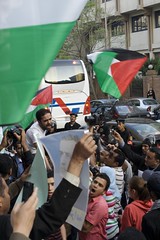
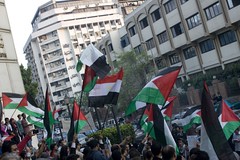
In recent days meanwhile Egyptian state security forces have maintained a detention craze by arresting students all over Egypt speaking out against Israeli acts of aggression at the Al-Aqsa Mosque in Jerusalem:
Cairo, March 27, 2010
The Arabic Network for Human Rights strongly condemned the escalation of the systematic crackdown on students waged by state security. The crackdown reached its climax when SSI arrested Ibrahim Megahed, 18 years, because of a wall journal he posted at the Poly Technique Institute of Quaisna, Menoufia. SSI also kidnapped three other students :Ibrahim Ali Farag, Mohamed Samir and Mohamed Nasr Ahmed in front of the Faculty of Engineering Zagazig University on Tuesday, March 23, 2010.
The Arabic Network for Human Rights strongly condemned the escalation of the systematic crackdown on students waged by state security. The crackdown reached its climax when SSI arrested Ibrahim Megahed, 18 years, because of a wall journal he posted at the Poly Technique Institute of Quaisna, Menoufia. SSI also kidnapped three other students :Ibrahim Ali Farag, Mohamed Samir and Mohamed Nasr Ahmed in front of the Faculty of Engineering Zagazig University on Tuesday, March 23, 2010.
The student, Ibrahim Megahed, had posted a wall journal reporting on the risks threatening Al Aqsa Mosque due to the violations committed by the Israeli occupation forces. He was arrested on campus and physically abused. Instead of releasing him as per prosecution order, SSI detained him in Damanhur prison, where he was denied contact with lawyers or family.
At Zagazig University in Sharkia , security services disregarded the sanctity of campus and kidnapped three students at the Faculty of Engineering in a proactive step lest they would stage or take part in a protest march against the continued arresting of students who would express anger over the Israeli aggression against Al Aqsa Mosque. The three students Ibrahim Ali Farag, Mohamed Samir and Mohammed Nasr Ahmed disappeared four days ago and could not be traced so far.
The Arabic Network for Human Rights Information said, “Law is no longer of any value to SSI. No student was ever arrested because of a wall journal but in Egypt. This is a bare faced, unashamed violation of freedom of expression, of the law and of all international treaties ratified by Egypt.”
Subscribe to:
Posts (Atom)